How Much Does Direct Mail Cost Per Piece? Complete 2026 Pricing Guide
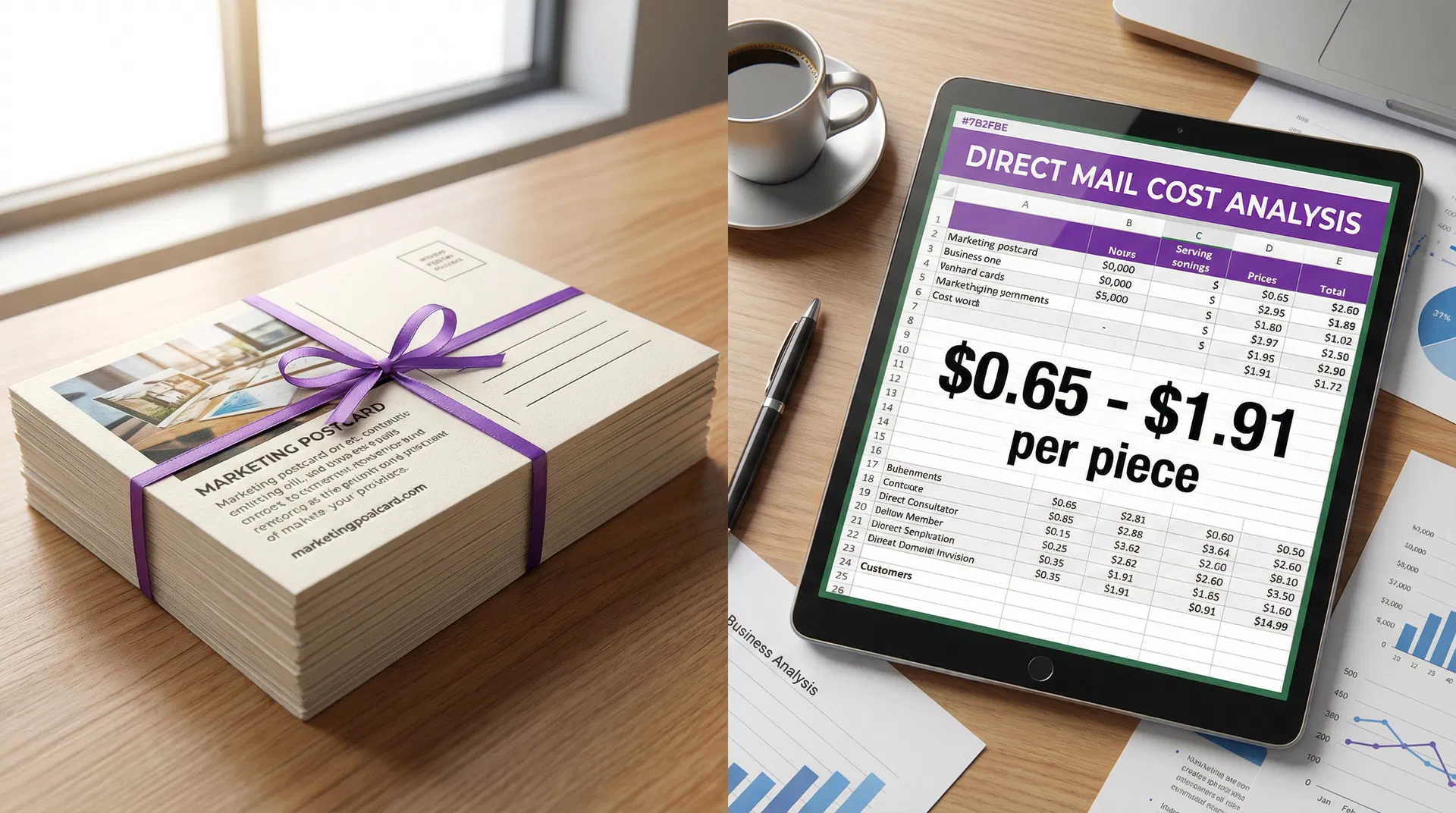
Direct mail costs $0.65 to $1.91 per piece for most businesses. Complete breakdown of printing, postage, list, and design costs with volume discounts, hidden fees, and cost-saving strategies.
Share This Article
How Much Does Direct Mail Cost Per Piece? Complete 2026 Pricing Guide
TL;DR: Direct mail costs $0.65 to $1.91 per piece for most businesses, with printing ($0.15-0.45), postage ($0.40-0.73), list/data ($0.05-0.25), and design ($0.05-0.48) making up the total. Volume discounts drop costs significantly—5,000 pieces cost $0.85 each while 500 pieces cost $1.80 each. This comprehensive guide breaks down every cost component, reveals hidden fees, shows you where to save money, and helps you calculate your exact cost per piece based on your specific needs.
Calculate Your Exact Direct Mail Cost
Get instant pricing for your specific campaign size, format, and business type. Our calculator shows you exactly what you'll pay—no surprises.
Table of Contents
- The Real Cost: What You'll Actually Pay
- Cost Breakdown: The Four Main Components
- Printing Costs: Paper, Ink, and Quality Levels
- Postage Rates: USPS Pricing in 2026
- List and Data Costs: Finding Your Audience
- Design Costs: DIY vs Professional
- Volume Discounts: The Sweet Spot
- Hidden Costs You Need to Know
- How to Reduce Your Cost Per Piece
- FAQ: Your Direct Mail Cost Questions Answered
- Conclusion: Planning Your Budget
The Real Cost: What You'll Actually Pay
The average cost per piece for direct mail in 2026 ranges from $0.65 to $1.91, depending on five key factors: quantity, format, printing quality, mailing class, and whether you're using your own list or purchasing data.
Here's what businesses typically pay by mail format:
| Format | Size | Average Cost Per Piece | Best For |
|---|---|---|---|
| Standard Postcard | 4"x6" | $0.65 - $0.95 | High-volume campaigns, quick promotions |
| Large Postcard | 6"x9" | $0.95 - $1.35 | More visual impact, premium feel |
| Jumbo Postcard | 6"x11" | $1.35 - $1.75 | Maximum attention, detailed offers |
| Letter (1 sheet) | 8.5"x11" | $1.15 - $1.65 | Personalized messages, longer copy |
| Letter (multi-page) | 8.5"x11" | $1.65 - $2.50 | Complex offers, catalogs, packages |
Why the wide range? A business mailing 500 standard postcards with basic printing will pay around $1.80 per piece. The same business mailing 10,000 pieces with premium printing drops to $0.75 per piece—a 58% reduction purely from volume.
The most cost-effective approach for most businesses is ordering 5,000-10,000 pieces using standard postcards with professional design and First-Class Mail. This typically costs $0.85-1.10 per piece and delivers the best balance of quality, deliverability, and economies of scale.
Cost Breakdown: The Four Main Components
Every direct mail piece has four cost components. Understanding each helps you identify where to optimize your budget.
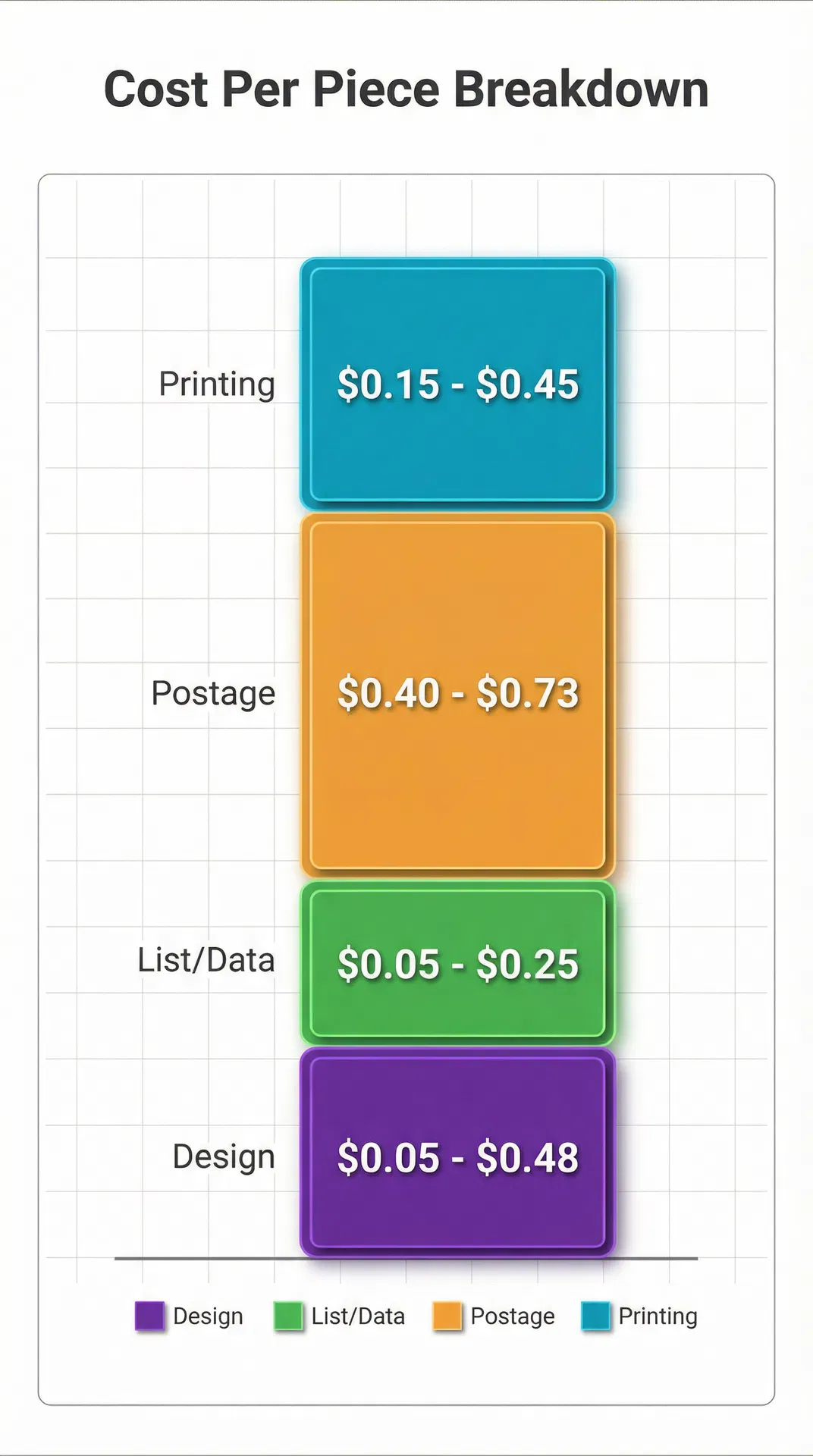
1. Printing Costs ($0.15 - $0.45 per piece)
Printing is typically the largest variable cost and includes paper stock, ink, finishing, and production labor. The cost depends on:
- Paper quality: 80lb gloss cardstock ($0.15) vs 130lb premium matte ($0.35)
- Color: Full-color 4/4 ($0.25) vs black and white ($0.10)
- Finishing: Standard cut ($0.00) vs rounded corners/UV coating ($0.10-0.20)
- Quantity: 500 pieces ($0.45 each) vs 10,000 pieces ($0.18 each)
2. Postage Costs ($0.40 - $0.73 per piece)
Postage is a fixed cost per piece set by USPS and depends on mail class and format:
- First-Class Mail Postcard (4"x6"): $0.53
- First-Class Mail Letter (1 oz): $0.73
- Marketing Mail Postcard (bulk rate, 200+ minimum): $0.40
- Marketing Mail Letter (bulk rate, 200+ minimum): $0.50-0.60
First-Class delivers faster (1-3 days) and includes forwarding/return service. Marketing Mail costs less but takes 7-14 days and doesn't forward.
3. List/Data Costs ($0.05 - $0.25 per piece)
If you don't have your own mailing list, you'll need to purchase or rent one:
- Your own list (email → address append): $0.05-0.10 per match
- Purchased consumer list: $0.10-0.15 per name
- Purchased business list: $0.15-0.25 per name
- Highly targeted specialty list: $0.25-0.50 per name
Most businesses pay $0.10-0.15 per name for quality data with demographic or firmographic targeting.
4. Design Costs ($0.05 - $0.48 per piece)
Design is a one-time cost amortized across your print quantity:
- DIY template (Canva, Photoshop): $0 upfront, $0.00 per piece
- Freelance designer ($200-500): $0.04-0.10 per piece (5,000 quantity)
- Professional agency ($1,000-2,400): $0.20-0.48 per piece (5,000 quantity)
- Reusing existing design: $0.00 per piece
For most businesses, spending $300-500 on professional design and reusing it across multiple campaigns provides the best ROI.
Printing Costs: Paper, Ink, and Quality Levels
Printing costs vary dramatically based on quality choices. Here's what you get at each price point:
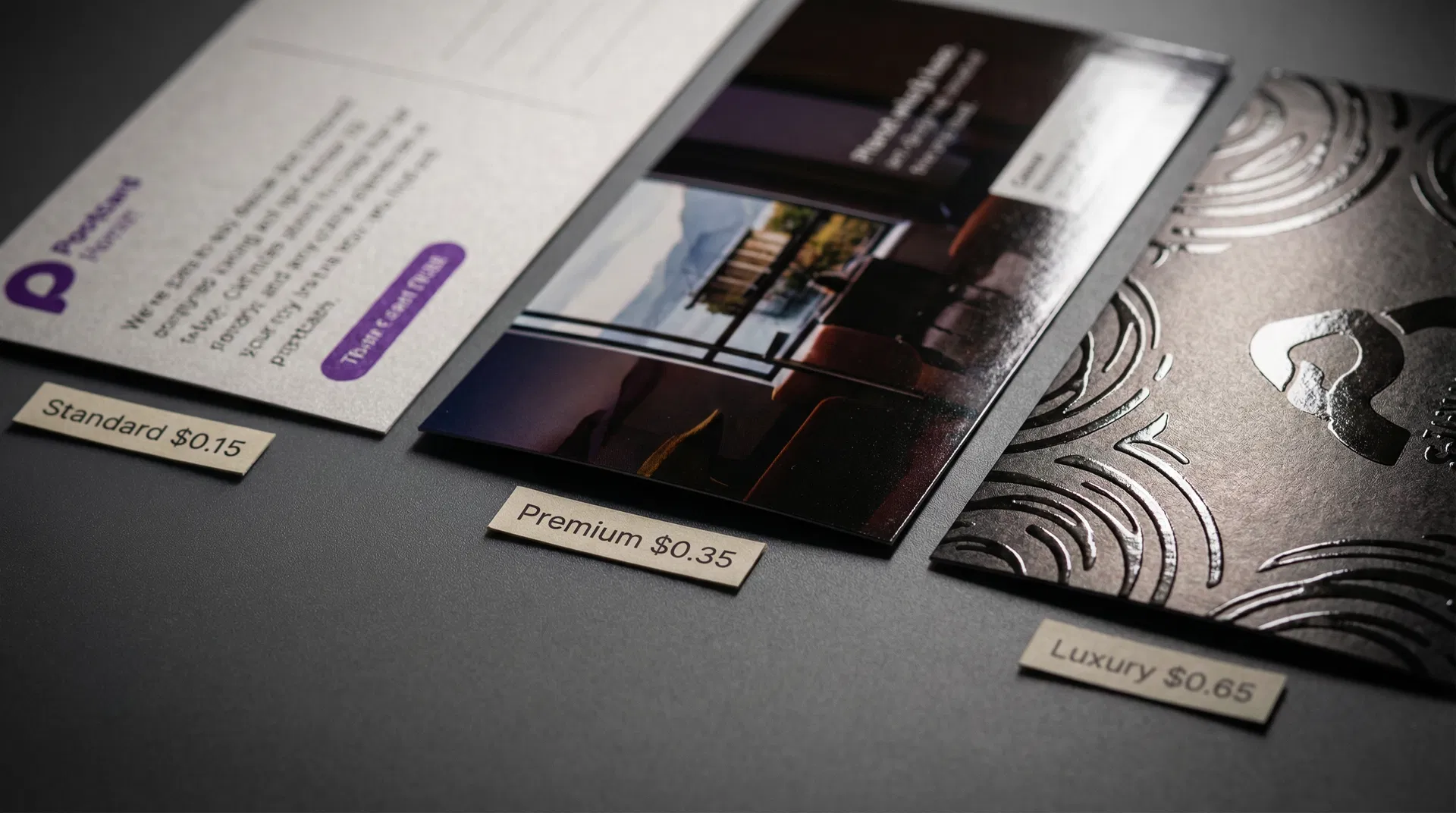
Standard Digital Printing ($0.15 - $0.22 per piece)
What you get:
- 80lb or 100lb gloss or matte cardstock
- Full-color CMYK printing (4/4)
- Standard square corners
- Digital press quality (300-600 DPI)
- 3-5 business day turnaround
Best for: High-volume campaigns where cost matters more than premium feel. Perfectly acceptable quality for most direct mail—recipients won't notice the difference unless comparing side-by-side.
Typical cost at 5,000 pieces: $0.18 per postcard
Premium Offset Printing ($0.28 - $0.38 per piece)
What you get:
- 110lb or 130lb premium cardstock
- Offset press quality (higher color accuracy)
- Options for rounded corners, spot UV, or soft-touch coating
- Richer, more vibrant colors
- 5-7 business day turnaround
Best for: Luxury brands, high-ticket offers, or campaigns where premium presentation increases perceived value. The tactile difference is noticeable—thicker stock and smoother finish signal quality.
Typical cost at 5,000 pieces: $0.32 per postcard
Luxury Specialty Printing ($0.50 - $0.85 per piece)
What you get:
- 14pt or 16pt ultra-thick cardstock
- Specialty finishes: embossing, foil stamping, die-cutting
- Silk lamination or suede coating
- Premium paper textures (linen, felt, recycled)
- 7-10 business day turnaround
Best for: Ultra-premium brands, VIP customer campaigns, or when you need to stand out in a crowded mailbox. These pieces feel like invitations, not ads.
Typical cost at 5,000 pieces: $0.65 per postcard
Recommendation: For most businesses, premium offset printing ($0.28-0.38) provides the best balance. The quality jump from standard to premium is significant, but premium to luxury shows diminishing returns unless your brand absolutely demands it.
Postage Rates: USPS Pricing in 2026
Postage is your second-largest cost and the least flexible—USPS sets the rates. Here's what you'll pay in 2026:
First-Class Mail (Recommended for Most Businesses)
| Format | Weight | Cost Per Piece | Delivery Time |
|---|---|---|---|
| Postcard (4"x6" to 6"x9") | N/A | $0.53 | 1-3 business days |
| Letter (1 oz) | Up to 1 oz | $0.73 | 1-3 business days |
| Letter (2 oz) | 1-2 oz | $0.98 | 1-3 business days |
| Letter (3 oz) | 2-3 oz | $1.23 | 1-3 business days |
| Large Envelope (1 oz) | Up to 1 oz | $1.39 | 1-3 business days |
Advantages:
- Fast delivery: 1-3 days vs 7-14 days for Marketing Mail
- Forwarding included: Follows recipients who moved
- Return service: Undeliverable mail comes back to you
- No minimum: Mail as few as 1 piece
Best for: Time-sensitive offers, abandoned cart recovery, VIP customer campaigns, or when you need guaranteed fast delivery.
Marketing Mail (Best for High-Volume Campaigns)
| Format | Minimum Quantity | Cost Per Piece | Delivery Time |
|---|---|---|---|
| Postcard | 200+ | $0.40 | 7-14 business days |
| Letter (1-3.3 oz) | 200+ | $0.50-0.60 | 7-14 business days |
| Flat (up to 16 oz) | 200+ | $0.75-1.20 | 7-14 business days |
Advantages:
- Lower cost: Save $0.13-0.23 per piece vs First-Class
- Bulk discounts: Additional savings at 5,000+ pieces
- Nonprofit rates: Even lower for qualified organizations
Disadvantages:
- Slower delivery: 7-14 days (sometimes longer)
- No forwarding: Doesn't follow people who moved
- No returns: You won't know if addresses are bad
- Minimum 200 pieces: Can't mail smaller batches
Best for: Large campaigns (5,000+ pieces) where speed isn't critical, such as seasonal promotions, new customer acquisition, or brand awareness.
Every Door Direct Mail (EDDM)
Cost: $0.21 per piece (postage only) Minimum: 200 pieces per route Delivery: 10-21 business days
How it works: You select carrier routes (neighborhoods) and mail to every address on the route—no mailing list needed. USPS delivers to every door.
Best for: Local businesses targeting specific neighborhoods (restaurants, gyms, home services). Cheapest option if you want geographic saturation without buying a list.
Catch: You can't target by demographics—you're mailing to everyone on the route, including apartments, businesses, and vacant addresses.
List and Data Costs: Finding Your Audience
If you don't have a mailing list, you'll need to acquire one. Here are your options and costs:
Using Your Own Email List ($0.05 - $0.10 per match)
If you have customer emails but no mailing addresses, you can use address appending services to match emails to physical addresses.
How it works: Upload your email list to a data provider (Melissa Data, Experian, Acxiom). They match emails to their database of 200+ million US addresses and return the matches.
Match rates: Typically 40-60% of emails will match to a valid mailing address.
Cost: $0.05-0.10 per matched address (you only pay for successful matches)
Best for: E-commerce businesses with large email lists who want to add direct mail to their marketing mix.
Purchasing Consumer Lists ($0.10 - $0.15 per name)
Consumer lists let you target households by demographics, behaviors, or interests.
Targeting options:
- Demographics: Age, income, home value, marital status, presence of children
- Behavioral: Recent movers, new homeowners, mail-order buyers, donors
- Interests: Hobbies, magazine subscriptions, vehicle ownership, pet owners
Cost: $0.10-0.15 per name for standard targeting (age + income + location)
Minimum order: Usually 5,000 names
Best for: B2C businesses targeting specific customer profiles (e.g., "homeowners age 35-55 with household income $75K+ in ZIP codes 90210, 90211").
Purchasing Business Lists ($0.15 - $0.25 per name)
Business lists target companies by industry, size, revenue, or job title.
Targeting options:
- Firmographics: Industry (NAICS code), employee count, annual revenue, years in business
- Job titles: CEO, CFO, Marketing Director, IT Manager, etc.
- Technographics: Companies using specific software/technology
- Intent data: Companies researching specific solutions
Cost: $0.15-0.25 per name for standard targeting (industry + size + location)
Minimum order: Usually 1,000 names
Best for: B2B businesses targeting decision-makers at specific types of companies (e.g., "CFOs at manufacturing companies with 50-500 employees in California").
Specialty Lists ($0.25 - $0.50+ per name)
Highly targeted or hard-to-reach audiences cost more:
- High-net-worth individuals ($0.35-0.50)
- C-suite executives at Fortune 1000 ($0.40-0.60)
- Recent life events (new parents, engaged couples): $0.30-0.45
- Medical professionals (doctors, dentists): $0.30-0.50
Best for: Niche B2B or luxury B2C offers where precision targeting justifies the higher cost.
Design Costs: DIY vs Professional
Design is a one-time cost, but it dramatically affects response rates. Here's what to expect at each level:
DIY Template Design ($0 - $50 upfront)
Tools: Canva, Adobe Express, Photoshop, Illustrator
Cost: $0 (free tools) to $50 (premium templates)
Time investment: 2-6 hours for first design
Pros:
- Lowest upfront cost
- Full control over changes
- Fast iterations
Cons:
- Amateur look if you lack design skills
- Easy to make rookie mistakes (wrong bleed, low resolution, poor hierarchy)
- No strategic copywriting guidance
Best for: Very small budgets, simple offers, or businesses with in-house design talent.
Amortized cost at 5,000 pieces: $0.00-0.01 per piece
Freelance Designer ($200 - $500 per design)
Where to find: Upwork, Fiverr, 99designs, Dribbble
Deliverables: Print-ready PDF with proper bleed/trim, 2-3 revision rounds
Turnaround: 3-7 days
Pros:
- Professional look at reasonable cost
- Experienced with print specifications
- Can provide multiple concepts
Cons:
- Quality varies widely between freelancers
- May not include strategic copywriting
- Limited brand strategy input
Best for: Small to mid-size businesses who need professional design but can provide their own copy and strategy.
Amortized cost at 5,000 pieces: $0.04-0.10 per piece
Professional Agency ($1,000 - $2,400 per design)
What's included: Strategy session, copywriting, design, print production management
Deliverables: Multiple concepts, A/B test variations, print-ready files
Turnaround: 7-14 days
Pros:
- Strategic approach (not just pretty design)
- Professional copywriting optimized for response
- Brand consistency across campaigns
- Print production expertise
Cons:
- Higher upfront investment
- Longer timeline
- May require minimum project size
Best for: Mid to large businesses running ongoing campaigns where response rate optimization justifies the investment.
Amortized cost at 5,000 pieces: $0.20-0.48 per piece
Recommendation: If you're mailing 5,000+ pieces, invest in a freelance designer ($300-500) at minimum. Poor design can kill response rates—spending $300 on design but losing 1% response rate costs you far more than saving $300 and losing customers.
Volume Discounts: The Sweet Spot
Printing costs drop dramatically with volume. Here's the actual math:
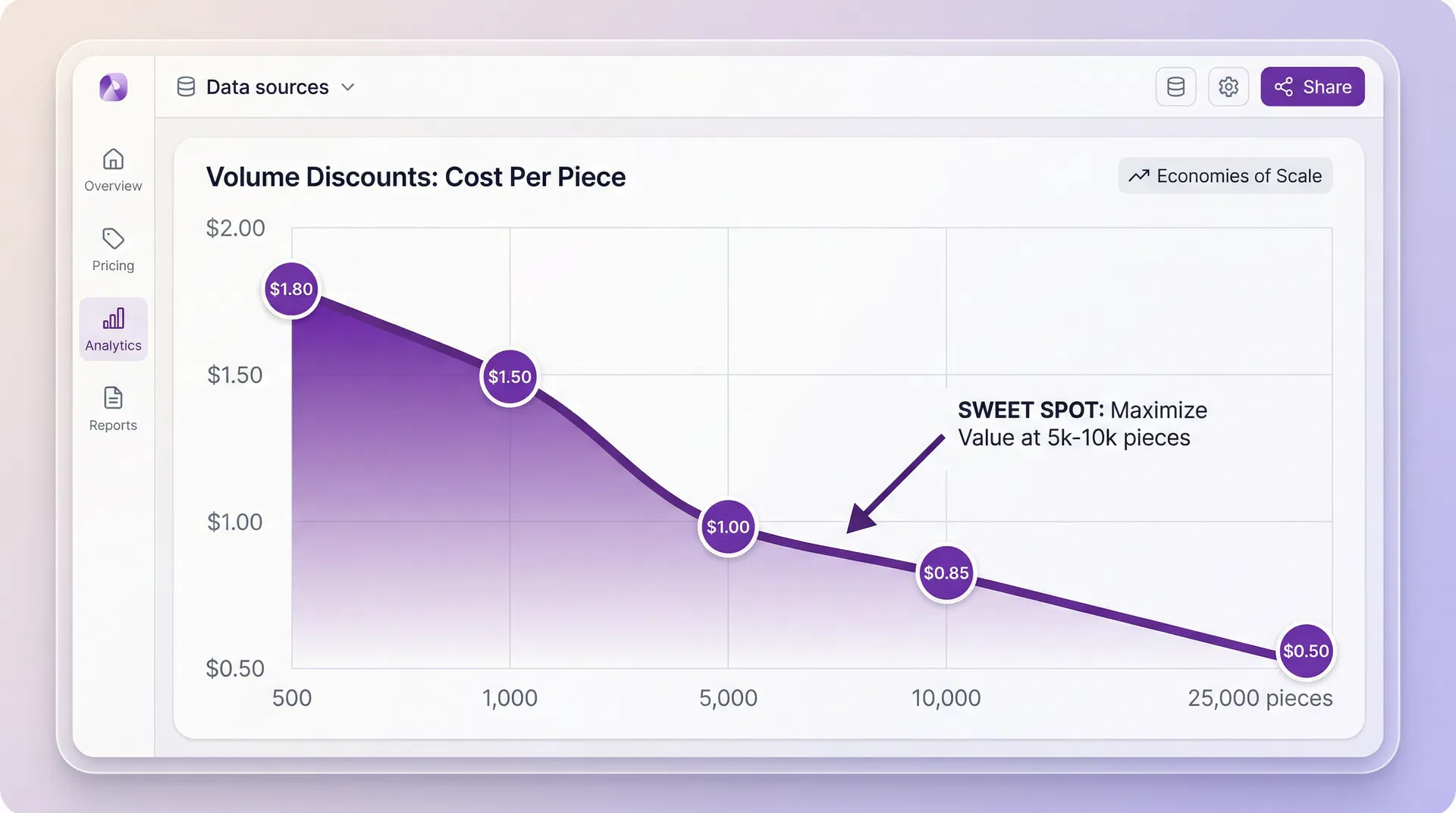
| Quantity | Printing Cost | Postage (First-Class) | List Cost | Design (amortized) | Total Per Piece | Total Campaign Cost |
|---|---|---|---|---|---|---|
| 500 | $0.45 | $0.53 | $0.12 | $0.60 | $1.70 | $850 |
| 1,000 | $0.32 | $0.53 | $0.12 | $0.30 | $1.27 | $1,270 |
| 2,500 | $0.24 | $0.53 | $0.12 | $0.12 | $1.01 | $2,525 |
| 5,000 | $0.20 | $0.53 | $0.12 | $0.06 | $0.91 | $4,550 |
| 10,000 | $0.18 | $0.53 | $0.12 | $0.03 | $0.86 | $8,600 |
| 25,000 | $0.15 | $0.53 | $0.12 | $0.01 | $0.81 | $20,250 |
Key insights:
-
The biggest drop happens from 500 to 2,500 pieces: Cost per piece falls from $1.70 to $1.01 (41% reduction)
-
The sweet spot is 5,000-10,000 pieces: You capture most volume discounts without over-committing inventory
-
Beyond 10,000, gains diminish: Dropping from $0.86 to $0.81 (6% reduction) isn't worth the risk if you're testing a new campaign
-
Design costs matter more at low volumes: At 500 pieces, a $300 design adds $0.60 per piece. At 10,000 pieces, it adds $0.03 per piece.
Strategy: If you're testing a new offer, start with 2,500-5,000 pieces. Once you prove the campaign works, scale to 10,000-25,000 to maximize ROI.
Hidden Costs You Need to Know
Beyond the four main components, watch for these often-overlooked costs:
1. List Hygiene and NCOA ($0.01 - $0.03 per piece)
What it is: Cleaning your mailing list to remove bad addresses and update people who moved.
Why it matters: Mailing to bad addresses wastes money. USPS requires NCOA (National Change of Address) processing for Marketing Mail.
Cost: $0.01-0.03 per address
When you need it: Every time you mail, especially if your list is more than 90 days old.
2. Mail Preparation and Sorting ($0.02 - $0.05 per piece)
What it is: Organizing mail by ZIP code, applying barcodes, and bundling for USPS drop-off.
Why it matters: Required for Marketing Mail bulk rates. Improper sorting gets rejected by USPS.
Cost: $0.02-0.05 per piece (some printers include this, others charge separately)
When you need it: Any Marketing Mail campaign (not needed for First-Class)
3. Permit Fees ($250 - $500 per year)
What it is: Annual fee to use Marketing Mail bulk rates at your local post office.
Why it matters: You can't use bulk rates without a permit.
Cost: $250-500 per year depending on post office
When you need it: If you're mailing Marketing Mail regularly (not needed for First-Class)
4. Variable Data Printing ($0.03 - $0.08 per piece)
What it is: Personalizing each piece with recipient name, custom offers, or unique URLs.
Why it matters: Personalization increases response rates by 20-40%, but adds printing complexity.
Cost: $0.03-0.08 per piece depending on complexity
When you need it: High-value campaigns where personalization ROI justifies the cost
5. Proofing and Revisions ($50 - $200 per round)
What it is: Physical printed samples before full production run.
Why it matters: Catches color, layout, or copy errors before you print 10,000 pieces.
Cost: $50-200 per proof round
When you need it: First time using a new printer, complex designs, or high-stakes campaigns
Total hidden costs: Add $0.06-0.16 per piece to your base estimate, or $300-800 in one-time setup fees for new campaigns.
How to Reduce Your Cost Per Piece
Here are proven strategies to cut costs without sacrificing results:
1. Increase Your Print Quantity
Savings: 20-40% reduction in printing costs
How: Order 5,000-10,000 pieces instead of 500-1,000. Even if you don't mail them all at once, storing extras is cheaper than multiple small print runs.
Example: Printing 5,000 postcards costs $0.20 each. Printing 500 costs $0.45 each. You save $1,250 by ordering more upfront.
2. Use Marketing Mail Instead of First-Class
Savings: $0.13-0.23 per piece on postage
Trade-off: Slower delivery (7-14 days vs 1-3 days) and no forwarding
Best for: Non-urgent campaigns with 5,000+ pieces where speed doesn't matter
Example: Mailing 10,000 postcards via Marketing Mail ($0.40) instead of First-Class ($0.53) saves $1,300.
3. Use Your Own List Instead of Purchasing Data
Savings: $0.10-0.25 per piece
How: Build your email list through lead magnets, then append addresses ($0.05-0.10 per match) instead of buying cold lists ($0.15-0.25 per name).
Example: Mailing to 5,000 appended addresses ($0.08 each) instead of purchased list ($0.15 each) saves $350.
4. Standardize Your Postcard Size
Savings: $0.10-0.30 per piece on printing and postage
How: Use 4"x6" or 6"x9" standard sizes instead of custom dimensions. Standard sizes qualify for lower postage rates and cheaper printing.
Example: A 6"x11" jumbo postcard costs $1.35 per piece. A 6"x9" large postcard costs $0.95 per piece. You save $2,000 on a 5,000-piece campaign.
5. Reuse Your Design Across Multiple Campaigns
Savings: $0.04-0.48 per piece on design costs
How: Create a template design with swappable headlines and offers. Pay for design once, use it 3-5 times.
Example: A $500 design used once costs $0.10 per piece (5,000 quantity). Used five times costs $0.02 per piece. You save $0.08 per piece = $400 per campaign.
6. Negotiate Printer Rates for Repeat Orders
Savings: 10-15% on printing costs
How: Commit to 3-6 campaigns per year with the same printer. They'll discount rates for guaranteed volume.
Example: Printing costs drop from $0.20 to $0.17 per piece with a volume commitment. On 30,000 pieces per year, you save $900.
7. Skip Premium Finishes Unless Necessary
Savings: $0.10-0.35 per piece
How: Use standard cardstock and finishes instead of rounded corners, UV coating, or specialty paper—unless your brand absolutely requires it.
Example: Premium printing costs $0.32 per piece. Standard costs $0.18 per piece. On 5,000 pieces, you save $700.
Bottom line: The easiest way to reduce cost per piece is increasing quantity and using Marketing Mail. These two changes alone can cut your cost from $1.70 to $0.85 per piece—a 50% reduction.
FAQ: Your Direct Mail Cost Questions Answered
How much does it cost to mail 1,000 postcards?
Mailing 1,000 standard 4"x6" postcards with professional design, premium printing, and First-Class postage costs $1,270 total, or $1.27 per piece. This breaks down to: printing ($0.32), postage ($0.53), list ($0.12), design ($0.30). Using Marketing Mail instead drops the cost to $1,070 ($1.07 per piece).
What's the cheapest way to send direct mail?
The cheapest option is Every Door Direct Mail (EDDM) at $0.21 postage + $0.15-0.20 printing = $0.36-0.41 per piece. You select carrier routes and mail to every address without buying a list. Best for local businesses targeting specific neighborhoods. The trade-off: no demographic targeting and slower delivery (10-21 days).
Is it cheaper to print postcards or letters?
Postcards are cheaper. A standard postcard costs $0.65-0.95 per piece while a letter costs $1.15-1.65 per piece. Postcards have lower printing costs (single sheet vs folded insert + envelope) and lower postage ($0.53 vs $0.73 for First-Class). Use letters only when you need more space for complex offers or personalized messages.
How much does direct mail cost for small business?
Small businesses typically spend $2,500-5,000 per campaign mailing 2,500-5,000 pieces at $0.95-1.10 per piece. This includes professional design, premium printing, purchased list, and First-Class postage. For tighter budgets, use Marketing Mail and increase quantity to 5,000 pieces to drop cost to $0.75-0.85 per piece ($3,750-4,250 total).
What's the ROI on direct mail?
Direct mail ROI varies by industry and offer, but the average response rate is 4.4% for prospect lists and 9% for house lists (your own customers). If your average order value is $100 and you mail 5,000 pieces at $0.90 each ($4,500 total), a 4.4% response rate generates 220 orders = $22,000 revenue = 389% ROI. High-ticket offers ($500+) can achieve 1000%+ ROI.
How much does it cost to buy a mailing list?
Consumer mailing lists cost $0.10-0.15 per name for standard demographic targeting (age, income, location). Business lists cost $0.15-0.25 per name for firmographic targeting (industry, company size, job title). Specialty lists (high-net-worth, C-suite executives) cost $0.25-0.50+ per name. Minimum orders are typically 1,000-5,000 names depending on the provider.
Can I print direct mail myself to save money?
You can print small quantities (under 100 pieces) on a home or office printer, but it's rarely cost-effective for larger campaigns. Commercial printers achieve $0.15-0.22 per piece at 5,000 quantity—far cheaper than home printing when you factor in paper, ink, and labor. Plus, commercial printers handle USPS requirements (barcodes, sorting) that home printers can't.
What's the difference between First-Class and Marketing Mail?
First-Class Mail costs $0.53 per postcard, delivers in 1-3 days, includes forwarding and return service, and has no minimum quantity. Marketing Mail costs $0.40 per postcard, delivers in 7-14 days, doesn't forward or return, and requires 200+ pieces. Use First-Class for time-sensitive offers or VIP customers. Use Marketing Mail for large campaigns (5,000+) where speed doesn't matter.
How long does it take to produce a direct mail campaign?
Total timeline: 2-4 weeks from start to mailboxes. Design takes 3-7 days, printing takes 3-7 days, and delivery takes 1-14 days depending on mail class. Rush options are available (24-48 hour printing) but cost 30-50% more. Plan campaigns at least 4 weeks before your target mail date to avoid rush fees.
Do I need a mailing permit?
You need a Marketing Mail permit ($250-500 per year) if you're using bulk rates for Marketing Mail. You don't need a permit for First-Class Mail—just buy stamps or use a postage meter. If you're mailing regularly (3+ campaigns per year), a permit saves money. For one-off campaigns, use First-Class to avoid the permit fee.
Conclusion: Planning Your Budget
Direct mail costs $0.65-1.91 per piece depending on format, quantity, printing quality, and mailing class. For most businesses, the optimal approach is:
- Format: 6"x9" postcard (best balance of impact and cost)
- Quantity: 5,000-10,000 pieces (captures volume discounts)
- Printing: Premium offset ($0.28-0.38 per piece)
- Postage: First-Class for urgent campaigns, Marketing Mail for large campaigns
- List: Use your own list with address appending when possible
- Design: Invest $300-500 in professional design, reuse across campaigns
Total cost: $0.85-1.10 per piece or $4,250-5,500 for a 5,000-piece campaign.
The key to maximizing ROI isn't just minimizing cost—it's optimizing the balance between cost and response rate. A campaign that costs $0.65 per piece but generates a 2% response rate loses to a campaign that costs $1.10 per piece but generates a 5% response rate.
Next steps:
- Calculate your exact cost based on your specific campaign parameters
- Test with 2,500-5,000 pieces to prove your offer works
- Scale to 10,000-25,000 pieces once you've validated response rates
- Track ROI religiously so you know which campaigns to repeat
Related Articles

Direct Mail List Appending Cost: Complete Pricing Guide 2026
List appending costs $0.05-0.15 per record with 60-95% match rates. Complete pricing breakdown by provider tier, data field type, and volume discounts with ROI calculations and implementation guide.
Direct Mail for E-Commerce Stores: Complete Strategy Guide 2026
18-25% abandoned cart recovery rates vs email's 8-12%. Direct mail cuts through inbox noise for e-commerce stores with proven strategies for cart recovery, retention, and acquisition.

Postcard Marketing for Online Businesses: Strategy & ROI Guide 2026
Postcard marketing delivers 4.25% response rates for online businesses at $0.65-1.10 per piece. Complete strategy guide for e-commerce and info products with design templates and ROI calculations.